

New pencils, a working backpack, and a class schedule are easy to see on a back-to-school checklist. A child’s vision is less obvious. Many students can read a line across a room and still struggle when their eyes must shift between a whiteboard and a worksheet, hold words in focus, or work together during sustained reading.
That is why a school vision screening should be treated as useful information, not the full story of the health of a child’s eyes. A screening helps identify students who may need further care. A comprehensive eye exam, performed by an optometrist, takes a closer look at vision, eye function, and eye health.
For Boise families, getting an exam before classes settle into full swing can make the first months of school more successful. If a student starts squinting, losing their place while reading, avoiding homework, or reporting headaches, parents and teachers will not have to wonder whether an unaddressed vision issue is part of the picture.
At Eye Pros, we provide comprehensive vision care for families in Boise and at locations across Idaho and Utah. Here is what parents should know about the difference between a school screening and a full pediatric eye exam, including the signs that deserve attention and the questions worth asking at an appointment.
A School Vision Screening Has a Specific Job
A vision screening is designed to be quick, practical, and useful for a group of children. Depending on the program and the child’s age, it may check distance visual acuity, eye alignment, or other basic indicators. A school nurse, pediatrician, family doctor, trained volunteer, or another qualified professional may conduct it.
The goal is to flag children who appear to need a more detailed assessment. The Centers for Disease Control and Prevention describes a screening as a way to identify children who need further eye care. That makes screening an important public health tool, especially when a child has never had their vision checked.
The result, however, is not a diagnosis. Passing means the student met the screening criteria on that day. It does not mean every visual skill or part of the eye was examined. Failing also does not tell a parent exactly what is wrong. It means a full evaluation is the appropriate next step.
Parents can think of a screening as a signal check. It can point toward a possible problem, but it is not built to answer every question about how a student sees during a full day of reading, writing, computer work, sports, and play.
Seeing the Board Is Only One Part of Classroom Vision
The familiar eye chart measures how clearly someone can see letters or symbols at a set distance. That information matters. Nearsightedness, farsightedness, and astigmatism can blur vision and make school tasks harder.
Yet classroom vision asks much more of a student. A child may need to look at a teacher, shift to a screen, copy a sentence onto paper, return to the original spot, and then read a passage at close range. Those tasks depend on several abilities working together.
A student needs to focus at different distances, move both eyes accurately across a line of print, keep the eyes aligned, judge depth, and sustain near work without excessive discomfort. Clear distance sight does not automatically confirm that every one of these functions is working as expected.
The American Optometric Association’s school age vision guidance notes that a child can have 20/20 distance vision and still have concerns involving focusing, tracking, or eye coordination. This is one reason a student may pass a basic screening but continue to complain that words blur, move, or seem difficult to follow during reading.
A screening is not failing the child when it does not answer those questions. It is simply doing a narrower job. A comprehensive exam is the setting designed to investigate the broader visual system.
What Happens During a Comprehensive Pediatric Eye Exam
The exact tests depend on a child’s age, symptoms, health history, and ability to respond. A good exam is adapted to the student rather than forcing every child through an identical sequence.
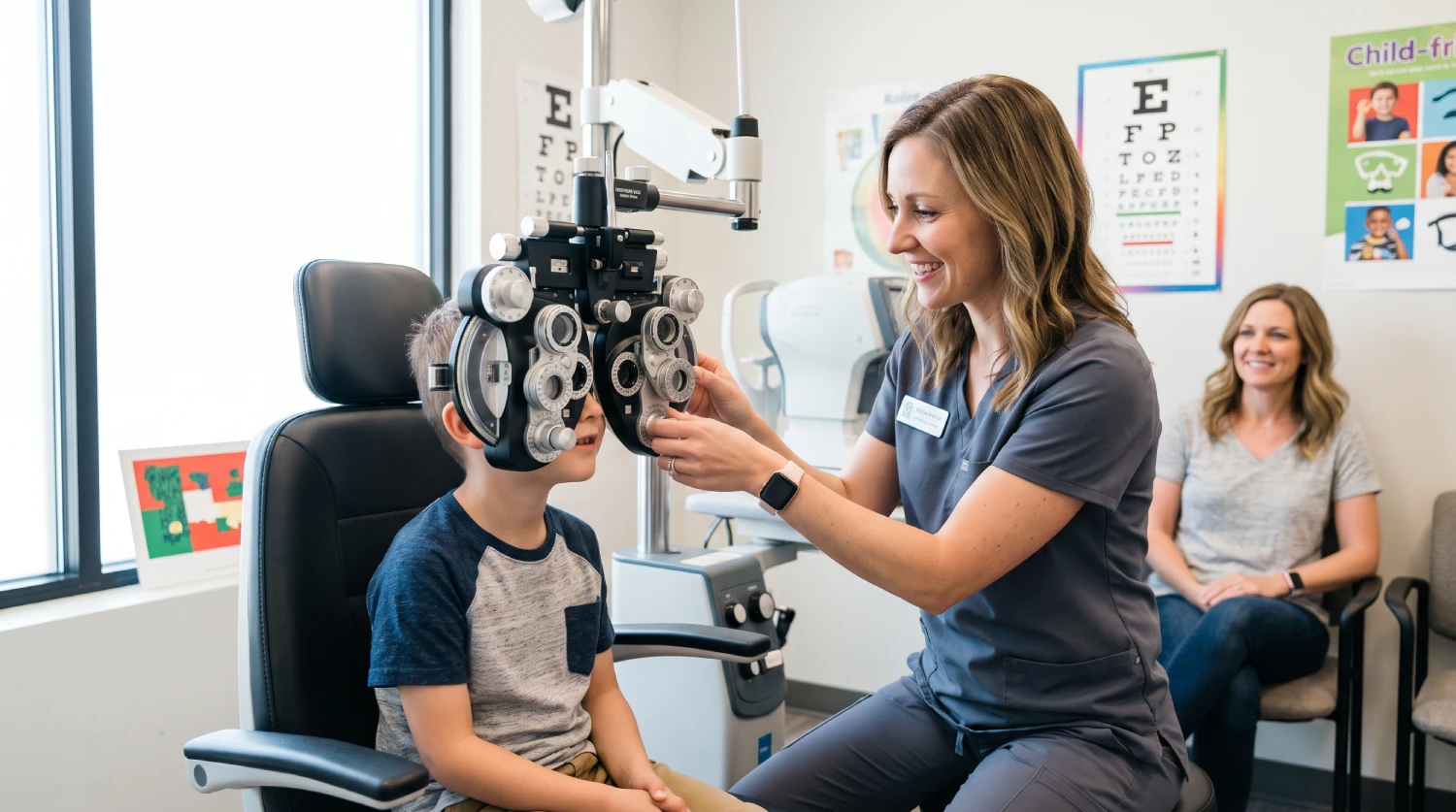
The visit usually begins with questions. Our optometrists may ask about the child’s general health, medications, birth and developmental history, previous eye care, family eye history, school performance, screen use, sports, and any symptoms noticed at home. This conversation matters because children do not always connect a headache or reading fatigue with their eyes.
The clinical portion may assess:
- Visual acuity at distance and near
- Refractive error, including nearsightedness, farsightedness, and astigmatism
- How well the eyes align and work as a pair
- Eye movements used for tracking and shifting attention
- Focusing ability at near and across different distances
- Depth perception and, when appropriate, color vision
- Pupil responses and visual fields
- The health of the front and back structures of the eyes
The AOA’s fact sheet on comprehensive exams for school age children includes patient history, acuity, refraction, binocular vision, eye movements, accommodation, and ocular health among the main components. Not every test is necessary in every case, but the scope is much wider than reading a chart at a screening station.
After testing, your eye doctor can explain what the results mean for school, sports, and daily activities. If the child needs glasses, treatment, monitoring, or a referral, the family leaves with a next step rather than a simple pass or refer result.
Children Often Adapt Instead of Complaining
Adults know when vision has changed because they remember how clear things looked before. Children may not have that reference point. A student who has always found near work tiring may assume reading feels the same for everyone.
Children also find workarounds. They move closer to a screen, choose a front row seat, enlarge text, close one eye, tilt their head, or avoid activities that feel uncomfortable. Some compensate well enough to keep their grades up, at least for a while.
That makes behavior an important source of information. A vision concern does not always sound like, “I cannot see.” It may look like frustration, slow reading, short attention during close work, or reluctance to start homework.
None of these behaviors proves that a child has an eye problem. Learning differences, sleep, stress, hearing, instruction, and other health factors can produce similar signs. An eye exam does not replace an educational or medical assessment. It helps rule vision in or out, giving parents and teachers better information for deciding what should happen next.
Signs Boise Parents Should Watch for During the School Year
One isolated complaint after a long day may not mean much. A repeated pattern deserves attention, particularly when it appears during reading, computer work, or distance viewing.
Watch for:
- Squinting or sitting unusually close to the television or classroom display
- Holding books or devices very near the face
- Frequent eye rubbing when the child is not tired
- Headaches after reading, homework, or screen use
- Covering one eye, closing one eye, or tilting the head to see
- Losing place, skipping lines, or using a finger to track well past the early reading years
- Complaints of blur, double vision, moving words, or tired eyes
- Avoiding reading or other close tasks that the child can otherwise understand
- A sudden drop in classroom participation or confidence
- Difficulty catching a ball or judging distance during sports
- One eye that appears to turn in, out, up, or down
- New light sensitivity, redness, pain, flashes, floaters, or a sudden change in sight
The CDC specifically advises having vision checked when a child squints, rubs their eyes, or reports headaches after schoolwork. Sudden vision loss, significant eye pain, an eye injury, or new flashes and floaters should receive prompt professional attention rather than waiting for a routine back-to-school visit.
Teachers may notice patterns that are hard to see at home. Ask whether the child copies accurately from the board, loses their place, avoids independent reading, or seems more fatigued during visually demanding lessons. Those observations can be helpful at the exam.
A Passed Screening Does Not Freeze Vision in Place
Children grow, and their eyes change with them. A student who passed a screening last year may have a different prescription this year. Nearsightedness often begins during the school years, and changes may occur between scheduled screening dates.
Daily demands change too. A third grader may spend longer reading independently than they did in second grade. A middle school student may move between printed work, a laptop, a phone, laboratory activities, and sports in one afternoon. A visual issue that was easy to compensate for can become more noticeable when the workload increases.
Glasses can also stop matching a child’s needs. Bent frames, scratched lenses, an outdated prescription, or a poor fit can interfere with comfortable vision. Bring current glasses and contact lenses to the appointment so we can consider how well they are working.
The AOA recommends a comprehensive exam before first grade and annually during the school years, with timing adjusted when an eye doctor identifies specific risks or concerns. A child’s own optometrist can recommend the schedule that fits their history. A school screening may still be worthwhile, even for a student who receives regular exams, because it adds another opportunity to notice change.
What an Exam Can Find Beyond a Simple Prescription
Many pediatric visits do result in an updated glasses prescription, but refraction is only part of the assessment. A comprehensive exam may identify or monitor several kinds of concerns.
Myopia causes distant objects to appear blurred. A student may see a book clearly while struggling with the board, signs, or a ball across a field. Hyperopia can place extra focusing demand on the eyes, especially during prolonged near work. Astigmatism can blur or distort sight at more than one distance.
Eye alignment concerns can affect how the two eyes work together. Amblyopia occurs when vision does not develop normally in one eye, or less often both eyes, during childhood. The stronger eye may compensate, so a child may not report an obvious problem. Convergence insufficiency can make close work uncomfortable or cause blur or double vision at near.
Our optometrists also evaluate eye health. Most children will not have an eye disease, but examining the structures of the eyes allows us to look for findings that a school chart cannot assess. When something falls outside routine optometric care, we can recommend follow up with the appropriate provider.
This broader view is the practical value of pediatric and kids eye exams. The point is not to search for a problem in every child. It is to learn whether the eyes are healthy and whether vision supports the tasks the student is being asked to do.
How Vision Can Affect Learning Without Explaining Everything
Vision and learning are connected because students take in so much information through their eyes. Blurred sight, uncomfortable focusing, or poor coordination can make a school task slower and more tiring. Correcting an identified vision problem may reduce that barrier.
Still, an eye exam is not a reading test, an attention assessment, or a diagnosis of a learning disability. Glasses do not teach phonics. Treating an eye condition does not replace classroom support, tutoring, or evaluation by other professionals when those services are needed.
That distinction protects families from two common mistakes. The first is assuming every school difficulty comes from vision. The second is assuming vision cannot be involved because a child is bright, reads at grade level, or passed a screening.
The useful question is narrower: does this student have a visual issue that is making school harder than it needs to be? A comprehensive exam can help answer it.
Screens, Homework, and Tired Eyes
Digital assignments are now part of many students’ routines. Sustained close work can contribute to temporary discomfort. Students may blink less while concentrating, and long periods without a distance break can leave the eyes feeling dry or tired.
Simple habits can help:
- Build short distance breaks into homework and recreational screen time
- Encourage full blinking when the eyes feel dry
- Keep the screen at a comfortable distance and angle
- Reduce glare from windows or bright lights
- Use a text size that does not require leaning forward
- Balance close work with outdoor time and physical activity
- Keep bedtime routines from being displaced by late screen use
These steps support comfort, but they should not be used to explain away repeated headaches, blur, double vision, or reading difficulty. If symptoms continue, an exam is more useful than endlessly adjusting brightness settings.
Prepare for the Appointment With a Short Record
Parents do not need a perfect symptom diary. A few specific notes can make the visit more productive.
Write down when the concern occurs, how long it lasts, and what the child is doing at the time. Note whether the problem happens at near, at distance, or both. Ask the child to describe what “tired” or “funny” vision means in their own words. Bring any school screening result, current glasses, contact lenses, medication list, insurance information, and relevant family eye history.
Useful questions include:
- Is my child’s distance and near vision clear for their age?
- Do both eyes focus, track, and work together as expected?
- Is the current prescription still appropriate?
- Are there signs that need treatment or monitoring?
- How often should this child return based on these findings?
- Are sports glasses, sunglasses, or other protective eyewear appropriate?
- What changes should prompt us to call before the next routine visit?
Tell your doctor about premature birth, previous eye injuries, developmental concerns, frequent headaches, diabetes, or a family history of significant eye conditions. That background can affect which tests and follow up are appropriate.
Choosing an Eye Doctor in Boise
Typing “Eye Doctor near me” into a search bar produces a long list, but proximity is only one factor for a child. Ask whether the office sees children in your student’s age group, provides comprehensive exams, and can explain findings in language both the parent and child understand.
Families searching for “Eye Exams Idaho” may also want to ask about appointment length, insurance, contact lens services for older students, emergency guidance, and access to glasses. At Eye Pros, most of our providers see children beginning at age five, while select providers see younger children. Confirm age availability when booking so our team can match your child with an appropriate doctor.
Our Boise office is located at 291 N. Milwaukee, Suite A-3. Our clinic provides eye exams and contact lens fittings, and our Boise page lists pediatric experience among members of the local doctor team. Families seeking an Optometrist in Idaho can review accepted vision insurance plans before the visit and confirm current benefits directly with the insurer and clinic.
Make the Eye Exam Part of the School Routine
The best time to investigate a possible vision issue is before a student has spent months compensating for it. A back-to-school exam gives the family a baseline, checks whether an existing prescription still works, and creates time to act on any finding.
Keep the school screening on the calendar. It is a useful layer of observation. Just do not ask it to do the work of a complete eye health and vision assessment.
If your child has not had a comprehensive exam, has a new symptom, or is wearing an older prescription, schedule a visit rather than waiting for a failed screening. Boise families can book an eye exam with our team and bring any school results or teacher observations to the appointment. A clear answer now can help the student begin the year with one less hidden obstacle.